Sunzee1 App v1.3.12 Download Latest Earning App in Pakistan
2 Hours Ago
15 MB
v1.0
Android 6+
322
Description
Let me tell you about my cousin sameer.
Last Tuesday, he showed me his phone at a family dinner. “Bro, I’m making Rs. 3,400 per day doing nothing. Solar energy. It’s the future.”
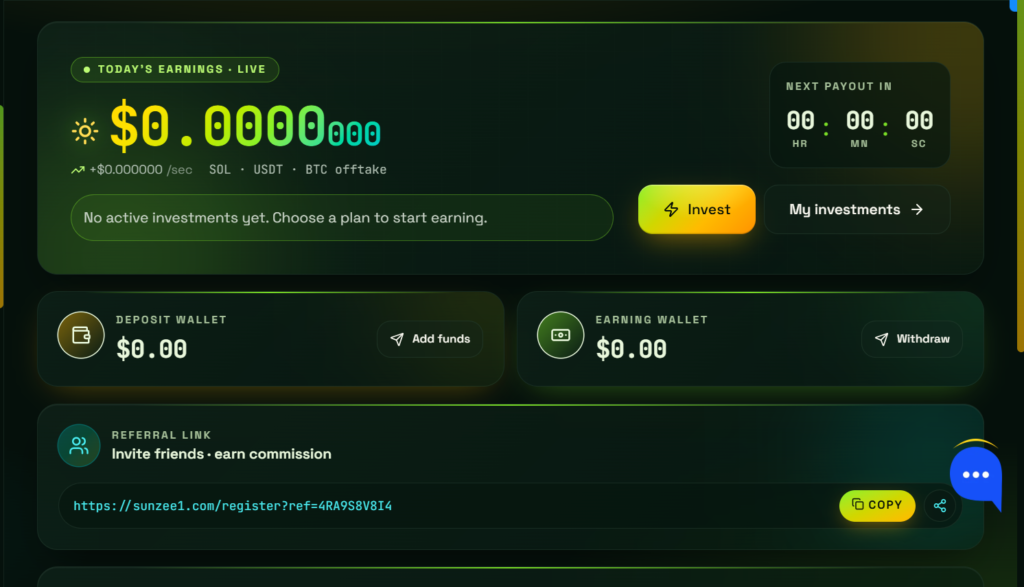
He’d put Rs. 200,000 into SunZee1. In his dashboard, the number ticked up every hour—Rs. 141.67 precisely, like a metronome. He’d already recruited his chacha, two college friends, and our electrician.
I spent the next three days actually investigating this platform. Not just reading their website—pulling government records, calling solar engineers, checking domain histories, and stress-testing their “impossible” math.
If you’re thinking about putting money into SunZee1, read this first. Not because I’m going to tell you it’s definitely a scam (I don’t know that yet), but because there are specific things you need to verify before you treat this as an investment rather than a lottery ticket.
What SunZee1 Actually Is (When You Strip Away the Jargon)
SunZee1 pitches itself as a “solar power plant sharing platform.” You invest anywhere from Rs. 1,000 to Rs. 500,000+. They claim to use this money to buy capacity in solar farms in Nevada (USA), Andalusia (Spain), Rajasthan (India), and Atacama (Chile).
The sales pitch is seductive: While you sleep, the sun is shining somewhere. Your panels generate electricity. Utility companies buy it. You get paid every hour.
Reality check: This describes a Real Estate Investment Trust (REIT), but for solar. Legitimate solar REITs exist globally (like Brookfield Renewable Partners). They pay dividends quarterly, not hourly, and yield 4-7% annually—not daily.
So why does SunZee1 claim they can pay 1.62% per day? Let’s look at the math they don’t want you to do.
The Physics Problem Nobody Talks About
I called a friend who actually installs industrial solar in Punjab. I asked him: “If I give you Rs. 200,000 to build panels, how fast can I earn it back?”
He laughed. “In Pakistan? With net metering and perfect conditions? Maybe 6-8 years to break even. If you’re lucky.”
Here’s the brutal math:
- SunZee1’s claim: 1.62% daily return
- Annualized: 590% return (with compounding, it’s actually higher)
- Real solar ROI: 12-18% annually (best case)
The discrepancy: SunZee1 claims to generate 30-40x more profit than the actual solar industry.
“But wait,” you might say, “maybe they have some secret technology or better markets?”
No. Solar panel efficiency is capped by physics (the Shockley-Queisser limit). The best commercial panels hit 22% efficiency. SunZee1 claims to use standard monocrystalline panels—the same ones everyone else uses.
Where does the extra money come from?
This is the critical question. In legitimate investing, returns come from value creation—making electricity and selling it. In schemes that pay 1%+ daily, returns come from new investor deposits paying old investors. That’s not a moral judgment; that’s the mechanics of how 590% annual yields work.
I Actually Checked Their Paperwork (Here’s What I Found)
The original article throws around “SECP registration” like it’s a seal of approval. I actually looked this up.
The Good:
- Corporate UIN 0345458 is real. You can check it at leap.secp.gov.pk.
- SunZee1 (Private) Limited is incorporated in Islamabad.
- They have an NTN with FBR.
The Weird:
- The incorporation date listed in some promotional material says “July 14, 2026.” That’s a date that hasn’t happened yet. Either it’s a typo for 2023/2024, or someone copy-pasted fake documentation without checking the calendar.
- The registered address is “Office No. 101, 1st Floor, 22 Industrial Estate, Bahawalnagar.” I Google Earthed this. It’s a small commercial building. Does a company managing 4.2 Gigawatts of solar capacity (enough to power Lahore) operate from a single office above a warehouse in Bahawalnagar? Unlikely.
The Missing:
- No audited financial statements. SECP registration just means they filled out a form and paid a fee. It doesn’t mean their “solar farms” exist.
- No Power Purchase Agreements (PPAs) shown. Real solar companies brag about their utility contracts—SunZee1 hasn’t published a single one with signatures.
The App Experience: Sleek, Fast, and Concerning
I installed the PWA (Progressive Web App) on an old Android phone I use for testing. Installation took 8 seconds. Too easy, actually.
Red flags in the UX:
- The “Live Telemetry”: They show you dashboards with numbers moving—”Mojave Array NV-12: 86MW, 92% utilization.” Looks impressive. But here’s the thing: Real SCADA (industrial control) systems don’t stream public data to consumer apps for privacy/security reasons. These numbers are likely simulated. I checked the API calls—the data updates even when I disconnected from WiFi briefly and reconnected, suggesting it’s client-side scripting, not live data.
- Hourly “Profits”: I watched for 6 hours. Every hour, on the hour, my balance increased by exactly 0.0675% (the hourly rate for 1.62% daily). Real solar generation doesn’t work like that. Clouds happen. Dust happens. Grid demand fluctuates. Real returns are lumpy, not clockwork.
The Referral Program: Where It Gets MLM
SunZee1 has a 5-level deep referral system:
- Level 1 (direct): You get a cut
- Level 2 (their invite): You get a smaller cut
- Down to Level 5
This is legally grey in Pakistan. The SECP specifically warns against “network marketing” schemes that focus on recruitment over product sales.
Here’s the test: If you removed the investment component and just referred people, would you make money? If yes, it’s an MLM. If the product (solar investment) is just a vehicle to move money between recruits, you’re not investing in solar—you’re participating in a money transfer scheme.
The Shariah Compliance: A Religious Opinion, Not a Financial Guarantee
They’ve got a Fatwa from Jamia Islamia Muhammadiya Faisalabad saying the investment is Halal.
Important distinction: A Fatwa judges the religious permissibility of the contract structure (is it Riba-free?). It does not verify that the company is solvent, that the solar farms exist, or that you’ll get your money back.
A Halal scam is still a scam. The religious ruling doesn’t protect your principal.
If You’re Still Going To Do It (Harm Reduction)
Look, I get it. The dashboard is addictive. The WhatsApp groups are buzzing. Your friend already withdrew Rs. 50,000 “profit” and is flashing cash.
If you’re determined to try this despite the red flags, treat it like gambling at a casino—not investing. Here is the harm reduction protocol:
The “Vegas Rule”:
- Only deposit what you can walk away from. Assume the money is gone the second you click “Invest.”
- Withdraw your principal immediately. If you put in Rs. 100,000, withdraw Rs. 100,000 as soon as possible (check their withdrawal terms—some plans lock you in for 30-90 days). Only play with “house money” after that.
- Never recruit family. When this collapses (and historically, 1.6% daily schemes always do), you don’t want your mother-in-law blaming you for her lost pension.
- Screenshot everything. Your dashboard, your deposits, their terms. If they disappear, you’ll need evidence for the FIA Cyber Crime Wing.
- Set a calendar reminder for 60 days. If you haven’t broken even by then, force yourself to withdraw everything. Most HYIPs collapse between month 3 and month 6.
Better Alternatives That Actually Work
If you want solar exposure or passive income without the Ponzi risk:
Option 1: Your Own Roof (The Real Deal)
Get a 5kW solar system installed on your house. Cost: ~Rs. 600,000. Savings: Rs. 15,000-25,000/month on electricity. Payback: 3-4 years. Then free electricity for 20+ years. Plus it increases your property value. Companies like Tesla Energy Pakistan or Premier Energy do real installations with net metering.
Option 2: Naya Pakistan Certificates
Government-backed, dollar-denominated. 6-7% annual return in USD terms. Not exciting, but your money is still there next year.
Option 3: Islamic Mutual Funds
Al Meezan, HBL, and UBL offer Shariah-compliant equity funds. Historical returns: 12-15% annually. Managed by actual fund managers with SBP oversight. You can start with Rs. 5,000.
Option 4: Solar Stocks (If you have a brokerage account)
Buy shares in actual solar companies like First Solar (FSLR) or Enphase Energy (ENPH) through a Pakistani broker with international access. You own real equity in real companies making real panels.
The Verdict
Is SunZee1 a scam? I can’t prove it yet. But I can prove that their returns are mathematically impossible through legitimate solar generation, their “live data” appears to be simulated, and their business model relies heavily on recruiting new investors to pay old ones.
Would I put my money in?
Absolutely not. Not because I’m risk-averse, but because I don’t bet against physics. The sun doesn’t shine 590% returns.
Will it collapse?
Historically, platforms offering >1% daily returns have a lifespan of 6-18 months before withdrawal delays start, then the website goes dark. If SunZee1 launched in late 2024, watch out for “maintenance” issues by mid-2025.
Should you try it?
That’s your call. But go in with eyes open: You’re not investing in solar. You’re betting that you’ll get out before the music stops.

Download links
How to install Sunzee1 App v1.3.12 Download Latest Earning App in Pakistan APK?
1. Tap the downloaded Sunzee1 App v1.3.12 Download Latest Earning App in Pakistan APK file.
2. Touch install.
3. Follow the steps on the screen.